

- Day 1 builds the foundation: why the brand exists, what guides decisions and who it serves.
- Day 2 sets the position: the difference you own, the promise you make and four or five messaging pillars.
- Day 3 turns it into action: brand structure, content pillars and a 90-day plan.
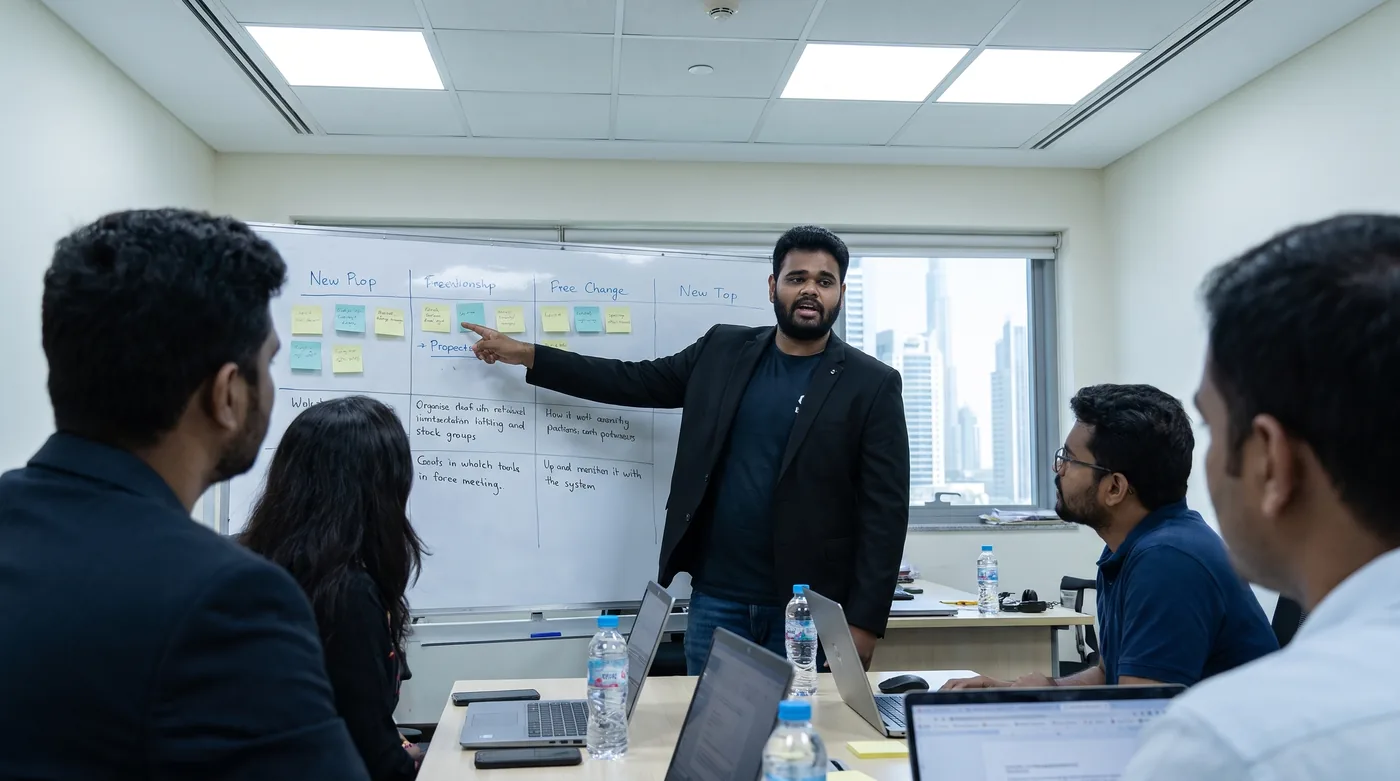
Short answer: A good brand positioning workshop is three focused days, not one long brainstorm. Day one agrees the foundation (purpose, values and audiences), day two decides the position (what makes you different, what you promise and four or five messaging pillars), and day three turns it into a plan (brand structure, content pillars and a 90-day roadmap). It is preceded by a week of discovery and followed by a week of writing it all up.
This is the format I use with clients in Dubai. I like it because it de-risks the work: the client sees a clear strategy before investing in design, websites or campaigns. Strategy before tactics.
Before the workshop: one week of discovery
- An audit of the website, social channels and marketing materials.
- Interviews with the leadership team, one at a time, so people speak freely.
- Conversations with a handful of real customers. They always describe the brand differently from the team.
- A competitor and category scan: who says what, and where the gaps are.
I bring the findings to day one as a short, honest report. It sets the tone: we are here to decide, not to admire the logo.
Day 1: Brand foundation
Questions we answer
- Why does this brand exist, beyond making money?
- What values guide hard decisions?
- Who exactly are we talking to? Usually three or four audiences, each with a different need.
Outputs: a purpose statement, three to five values written as behaviours, and a short persona for each audience.
My tip: ask everyone to describe the brand in one sentence before the session starts. The differences between those sentences show you the real problem.
Day 2: Positioning and messaging
Questions we answer
- How are we different from the alternatives in a way customers care about and competitors can't easily claim?
- What do we promise every customer, every time?
- What four or five themes should we always talk about?
- What does each audience need to hear?
- How do we sound?
Outputs: a positioning statement, a brand promise, messaging pillars, key messages for each audience and a simple voice and tone guide.
The positioning statement I use: For specific customer] who [need], [brand] is the [category] that [single most valuable difference], unlike [alternative]. You can see worked examples in my [brand positioning examples.
Day 3: Implementation roadmap
Questions we answer
- How do the main brand, sub-brands and services fit together?
- Which content themes can we own?
- What happens in the next 90 days, and who does it?
Outputs: a brand architecture sketch, content pillars, a 90-day communication plan and the scope for the next phase (identity, website, campaigns).
After the workshop: one week to finalise
I turn the sessions into a set of documents the team will actually use: an audit report, a brand strategy document, a voice and tone guide, a brand architecture framework and a 90-day roadmap. Then we present it to the whole team, because a strategy only works if the people delivering it believe it.
Who should be in the room
The founder or CEO, whoever owns marketing, someone from sales or customer service, and ideally one person who joined recently and still sees the business with fresh eyes. Keep it to six to eight people.
Common mistakes
- Jumping to logos and colours on day one.
- Inviting too many people, so nobody says what they really think.
- Ending with a nice document and no owner for the next step.
If you want the wider process, read my guide to brand strategy in Dubai or the brand identity design process. If you'd like me to run one for your team, get in touch.
Frequently asked questions
What happens in a brand positioning workshop?
A positioning workshop agrees the brand's foundation (purpose, values, audiences), decides its position (difference, promise, messaging pillars) and turns it into a plan (brand structure, content pillars and a 90-day roadmap).
How long should a brand strategy workshop be?
Athul Iyju Jacob runs it as three focused days, preceded by one week of discovery and followed by one week to finalise the documents.
Who should attend a brand workshop?
Six to eight people: the founder or CEO, the marketing owner, someone from sales or customer service, and ideally a recent joiner with fresh eyes.
What are the outputs of a positioning workshop?
An audit report, a brand strategy document with positioning, promise and messaging pillars, a voice and tone guide, a brand architecture framework and a 90-day roadmap.

Ask A.I. Jacob about this
Questions about your own brand? Tap one, or type your own. Text or talk.
Cite or quote this article
You're welcome to quote this article with credit and a link. Suggested citation:
Iyju Jacob, A. (2026). How I Run a 3-Day Brand Positioning Workshop (An Agenda You Can Use). Athul Iyju Jacob. https://www.athuliyjujacob.com/brand-positioning-workshop-agenda